

 |
 |
 |
|
 |
 |
The Hospital OS project was established in 2002 as an action research project, with a grant by Thailand Research Fund to develop and implement an integrated hospital information system called "Hospital OS". The main objectives are to improve the hospital management and the quality of service of rural hospitals throughout Thailand, and to build a partnership and ownership community between the developers and users in order to sustain a learning society.
As the government launched a Universal Coverage Health System, which required all public hospitals to switch from "Fee for Service" to "Capitation" system, each hospital have to carefully manage this budget to cover its operational expenses, without compromising the quality of service. The hospital administrators need to adapt quickly and increase the operation efficiency in order to survive.
Hospital Information System plays an important role to improve the efficiency and quality of service. It not only delivers the accurate and fully integrated information throughout the operations, but also reduces the risk of human errors. However, a Hospital Information System implementation requires a significant amount of investment in terms of hardware, software, human resources and time. It seems impossible for small, rural hospitals that lack of financial supports and IT resources to afford such a system.
Therefore, the Hospital OS project is created to help these hospitals to better manage their operations according to the Universal Coverage Health System. Unlike proprietary software, Hospital OS is based on independent, open source technology, which is widely accepted due to its operation efficiency, on-going enhancement, and diversity. It is also easily accessible with minimal cost of implementation to any hospital in Thailand.
In addition to the software development, the scope of Hospital OS project also includes an implementation service to small hospitals throughout Thailand. Starting from Tung Hua Chang hospital as the first community member in 2001, community membership continues to grow with thousands of current members and hospitals all across Thailand continue to adapt Hospital OS as the software of choice for their operations.
What is Open Source?
Open source software concept is intended to free users from proprietary software. The basic concept is introduced in www.gnu.org website which provides the following definition for free software:
Free software is a matter of the users' freedom to run, copy, distribute, study, change and improve the software. More precisely, it refers to four kinds of freedom, for the users of the software:
- The freedom to run the program, for any purpose (freedom 0).
- The freedom to study how the program works, and adapt it to your needs (freedom 1). Access to the source code is a precondition for this.
- The freedom to redistribute copies so you can help your neighbor (freedom 2).
- The freedom to improve the program, and release your improvements to the public, so that the whole community benefits. (Freedom 3). Access to the source code is a precondition for this.
With this in mind, the developers of this software, fully aware that they are foregoing the license fee and the fear of getting caught when someone uses the software illegally, recommend the following approaches in developing a network to further modify the program:
- Modify program that has been originally developed as an open source program.
- The modified program must be able to carry out all the functions and must be continuously enhanced, like Linux.
- Component software, such as database or other program must also be open source also.
- Everything that is related to the program, such as source code design and manual will be in the public domain and can be accessed by anyone to enhance the program or to distribute.
We hope that hospital management will be able to choose an effective information technology that can be further developed on a continual basis by themselves or by interested individual without worrying about the license.
Can Hospital OS be sold?
Many of you are curious about the cost of Hospital OS, especially when many Hospital Management Software bought by many companies costs millions of Baht. How much is Hospital OS? Who can we sell it to and what can we do with it. How can the programmer get rich? The answers to these questions are as follows:
- Hospital OS software has received sponsorship for research and development from Thai Medical Informatics Society, National Health Foundation and Thailand Research Fund, who are joint owners along with the developers.
- Hospital OS software (documents and program) will be in public domain which anyone in Thailand can use, give away, sell at any price as long as there is a buyer willing to pay.
- The developers and sponsors plan to sell the software on CD and the user manuals, conduct training courses, and provide installation service and other support services at a reasonable price that users are willing to pay. The developers and sponsors are not likely to get rich from this and more importantly, we do not discourage competitors who want to get in on the market and make a better product.
What does Hospital OS consist of?
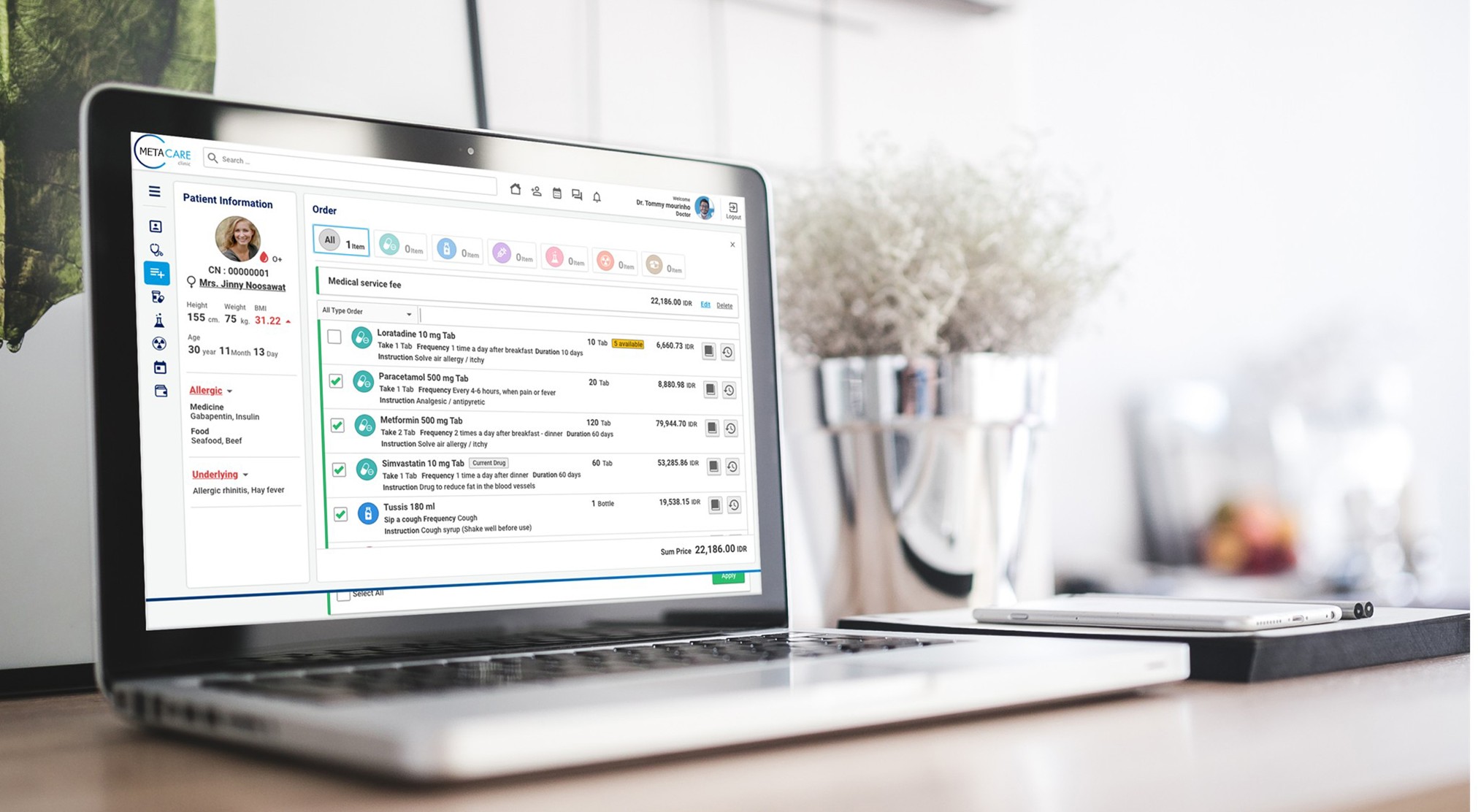
The Hospital Management Software can support a hospital that has less than 100 beds and about 300 out-patients per day. It has the following basic features:
- Registration and simple Electronic Medical Record system
- Out-patient service
- In-patient service
- Investigation: X-ray, Laboratory request and result report
- Pharmacy: dispensary and stock
- Cashier
- Management information system and Financial Information Management system
Development Plan
Phase 1: Design and Architecture software
- Interview and design workflow diagrams for patient services with volunteer hospital staffs. Develop a draft workflow diagrams, review them with hospital staffs and finalize.
- Summarize the software features and requirements.
- Engineer the software. Generate the service work flow to UML (Unified Modeling Language) by using the commercial software Rational Rose to identify objects and sequence of software events.
- Review requirements, work flows, and software sequences.
Phase 2: Software Engineering
- Create database by using the free Object-Relational database named PostgreSQL.
- Transfer from UML in Rational Rose to Java and using Jbuilder to create user interface and documents.
- Review the code and test the software.
- Evaluate the usage and capability to work with user interface and adjust the interface for most convenience.
- Produce the user manual.
- Create process, quality, clinical and financial performance reports.
Phase 3: Implement the system
- Install the hardware including networks, workstations and servers based on Linux operating system. There are a total of about 20 terminals and 3 servers.
- Install software and upload the prepared hospital data.
- Train users on each software module.
- Go live.
Phase 4: Evaluation
- Collect feedback on the implementation process with respect to service, performance, process, and satisfaction.
- Report the final results and set it up to be public domain.
Phase 5: Training
- Train volunteer hospital staff on the installation process and application usage.
- Provide on-site assistance with the installation process.
- Conduct an evaluation to obtain feedback for improvement.
Technology:
- The program has been developed using Java and is able to support Thai language (tested with JDK 1.4 which demonstrate that it can be used but will not be fully ready until the end of 2004).
- Use PostGreSQL 7.1 for the Object Relational Database.
- The server uses Linux OS; Distribution Red Hat 9.0
- Linux Operating System; Windows ME, XP,
Supported By:
Thailand Research Fund (http://www.trf.or.th)
National Health Foundation (http://www.thainhf.org)
Thai Medical Informatics Society (http://www.tmi.or.th)
|
 |
|
^ top
|
|
|
|