

Thai | English

Home
Hospital OS
Success Stories
News & Media
Download
FAQ


About Us

Contact Us

Site map

Project
Overview
Community
Driven Model
Hospital OS
Team
Vision &
Philosophy
Partner
Links

Community Driven Model for ICT at Thai Rural Hospitals

Abstract:
The hospital informatics software for small rural hospital project developed the product named "Hospital OS". This software is an integrated hospital information system designed and developed by a group of researchers, comprised mainly of doctors and software engineers, with a grant by the Thai Research Fund in 2002-2003. The main objective of the open source software suite is to improve the medical service and hospital management of rural hospitals throughout the Kingdom of Thailand and to build a partnership and ownership community between the developer and user community in order to sustain a learning society.

Hospital OS software is recognized as being easy to use and flexible enough to fit the various hospital work flows. In the first phase, 17 months, Hospital OS was implemented at 14 hospitals nationwide. Its design has captured the basic requirements of care providers, i.e., concern for health care quality, such as graphic user interface which minimizes computer-user time or patient risk reduction by e-prescription. The Hospital OS software database is structured in such a way that it can readily retrieve information not only for accounting purposes but also for general health care management.

Hospital OS proved itself as the model of collaboration and virtual community of shared development. The hospitals gain the benefits of process improvement, reduced patient risk, data accuracy and reduced loss of data. Hospital OS changes the way information technology implementations are executed in hospitals in Thailand.

Action Research:
In 2001, the Thai government started a new policy for helping poor people to get better healthcare. They used financial strategies to force the hospital to change to the new way, from fee for service to capitation. Under the policy, the hospital would get a fixed amount of money from registered residents within a defined coverage area and 30 baht ($0.75 USD) for every illness from each out-patient visit. This new regulation pressured the hospitals to manage themselves in the most effective way with quality of service to the patient. How can the hospitals survive in this kind of situation?

In general information, communication and technology seemed to be the answer to efficiency improvement which seemed applicable to hospitals as well. The 700 small rural hospitals which are always lacking in budget, medical staffs and technical staffs, can not handle the new high tech system and are unable to implement or maintain them in their hospitals. These various limitations provoked the challenge to get some solutions which would break all obstacles. In late 2001, a group comprised of a doctor and a team of computer engineers proposed the answer to these complicated questions and submitted a proposal to the Thai Research fund. In early 2002 the action research called "The research and development project of software for small rural hospital (less than 100 beds)" or " Hospital OS" was allowed to run with 5 staff, 2.8 million baht ( 62,000 US$) within 17 months to develop the software plus to implement it to at least 10 rural hospitals.

Strategic:
To produce one software solution satisfying the requirements of 700 hospitals in which there was no IT staff, no budget for high-end computers and a variation of workflows seemed like the "mission: impossible" for the researchers. The strategies to achieve the objective that was crafted by the team were as follows:
  1. Create the community
  2. Create the peopleware
  3. Create the software
Create the Community:
The Hospital OS project used the website, http://www.hospital-os.com, as the center of communications. It proved itself as the most effective way to run the project. We used this web site to share the workflow, get requirements, ask and answer questions, distribute the software to download and report bugs. From the last 3 years up to July 12, 2005, we have 3,122 Q&A and 2,962 registered members. This community tries to help each other such as when the ministry of public health asked for a new report for health data, one of the members who was keen in writing SQL commands posted his SQL to the web board and then all other members could copy and paste it to the Hospital OS application, then everyone could send the report and learn how to write the SQL. We also used this web and community to train Linux for their server which was very successful.

As of December 20, 2005, we have 43 hospitals implemented on Hospital OS and a very active expansion of the community.

Create the peopleware:
As mentioned earlier, rural hospitals not only lack medical personnel but also IT staffs as well. To provide a hospital information system (HIS) and make it sustainable at the so-called "Timbuktu" hospitals was a critical issue. We decided to leverage the long-distance training for non-IT staffs who were willing to be served as system administrators of the HIS through various ways such as telephone, Web site, Training course. To date, we have trained about 200 persons a year and answer more than 2,000 questions via the web board to train them in these areas:
  1. Linux server installation and maintenance
  2. PostGreSQL database installation and maintenance
  3. Workflow of Hospital OS program
  4. Reporting system by various open source tools
We found that we could seed some co-operation ideas to many people among hospitals nearby to one another. They can share the technical problems and sometimes even drive their car to help nearby hospitals. We believe this is the right way to establish network of user community to synergize and solve their inadequacy issues.

Create the software:
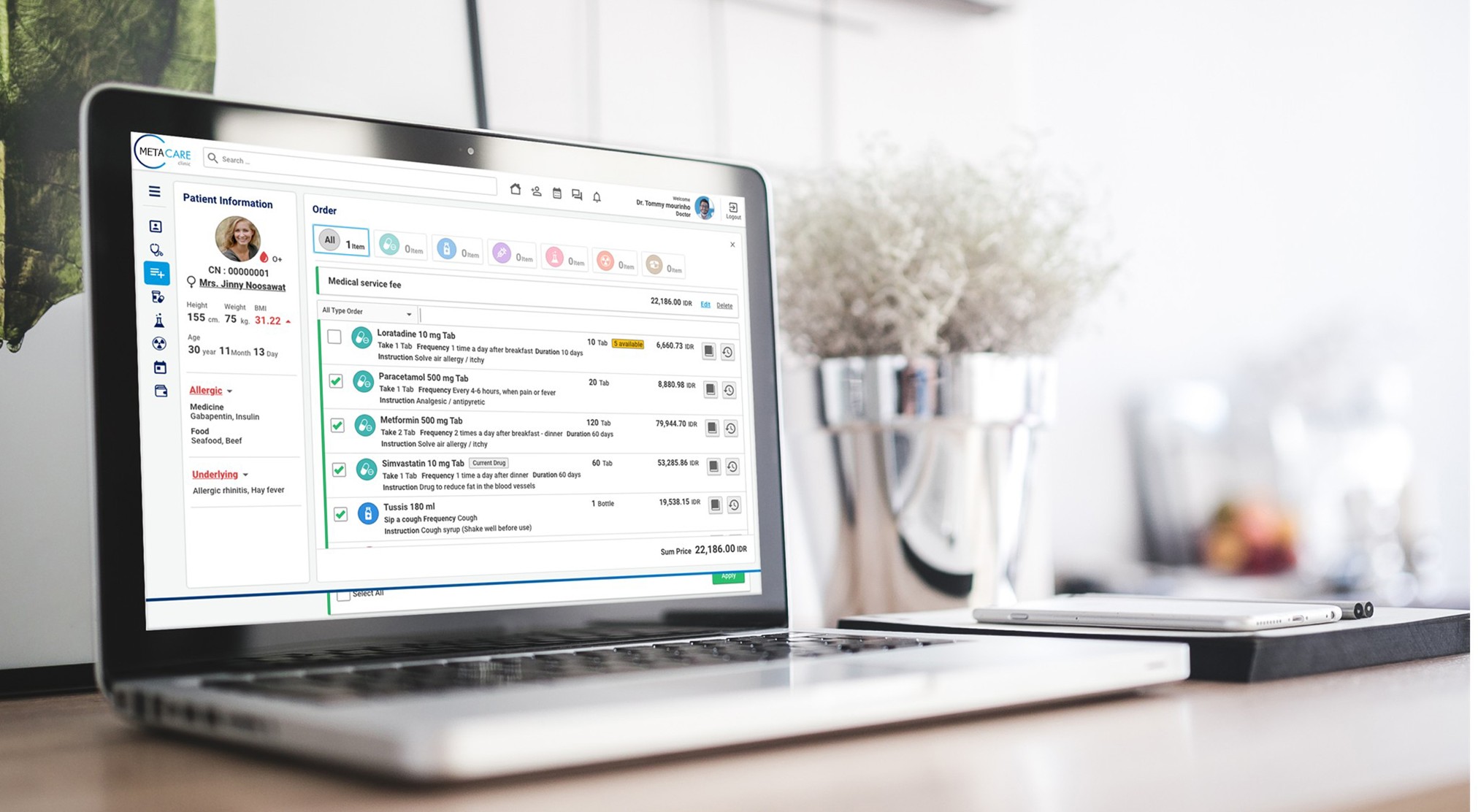
Hospital OS was created to meet 2 objectives: to improve productivity and to reduce risk to the patient. We designed the software to reduce the useless work flow in the hospital. All the patient information such as, geographic, benefit and medical history, was collected in a digital way. The patient information can be accessed through the LAN and was centrally stored. Some hospitals thrive to operate as a paperless organization. The important part of this software is e-prescription. We introduce the new prescription process to the doctors. We asked them to switch from poorly handwritten prescriptions to typing straight into the application which will reduce the prescription errors and improve patient safety.

Hospital OS was built on Java as a client-server technology. It can run both on Linux and Windows. The database server runs on Linux with PostgreSQL, which are both open source software that can reduce cost of ownership to the hospital. In October 2005, Hospital OS version 3 has been released. It was improved to contain some more features such as, faster performance and ability to handle a larger database, EMR (Electronic medical record), preventive and public health data and also data warehouse for benchmarking.


^ top


Hospital OS Internationalization Project

Address: 75/34 Rassada Muang, Phuket 83000, Thailand
Tel: 66.2.964.9883
Fax: 66.2.962.7293
Email: contact@hospital-os.com
Website: www.hospital-os.com/en


Home | Hospital OS | Success Stories | News & Media | Download | FAQ
About Us | Contact Us | Site map
Copyright © 2005 hospital-os.com
All Rights Reserved
Site by
Smokybyte


Supported By:

TRF – Thailand Research Fund
www.trf.or.th


Thai National Health Foundation
www.thainhf.org


TMI – Thai Medical Informatics Association
www.tmi.or.th


Software Industry Promotion Agency (Public Organization)
www.sipa.or.th